

Author:
Tom Nudell
Unpacking Piq's
new look
What Piq's new look means moving forward
Why I'm writing this
Our new website launched a couple weeks ago, and since then a lot of people have been asking me about the new look. What does it mean? Did we change our strategy? Did we change who we sell to?
The short answer is nothing core to Piq has changed. If anything, we have more conviction than ever in our strategy, the platform we built, and the way we work with customers.
The new brand reflects what Piq has been from the start: agentic planning to unlock the grid. That includes utilities, which now have their own section on the site. Not many people know this, but we built our first business plan in 2023 with the utility customer in mind, and we even ran our first proof of concept with a utility at the end of 2024. But then the developer use case took off so we leaned in and used that market to build out our technology.
Where Piq started
We started Piq because we saw a big problem in power grids around the world and an even bigger opportunity to solve it. My cofounder, Dio, and I, along with our founding engineers Daniel and Babis, had spent years running grid studies inside of and for utilities around the world. At every stop, grid studies were in the critical path. And most of the actual energy during a "study" went into the work around the computation, not the simulation itself.
In January 2023 we submitted a proposal to the NSF's Small Business Innovation Research (SBIR) program for autonomous grid planning. It laid out the three pillars that Piq is built on:
a reproducible automation layer, which is what makes agentic planning safe in the first place
an agent harness for running studies reliably
a data layer that connects information about the grid, enabling seamless transformation across different levels of grid physics + engineering.
The technology that lets agents run studies safely is the same technology that supports human engineers. The difference is what you build first—a flashy hyped up "AI tool" that gets a lot of attention but can't do reliable work, or a platform that can 100x human experts and solve problems today. We chose to start with human experts: a human-centric product, real customers, real impact, and real study data. We weren't going to build this company on hype, so we just sold the platform first, and quietly built the agent until it was extremely capable and highly trustworthy.
What we built
Speed and breadth
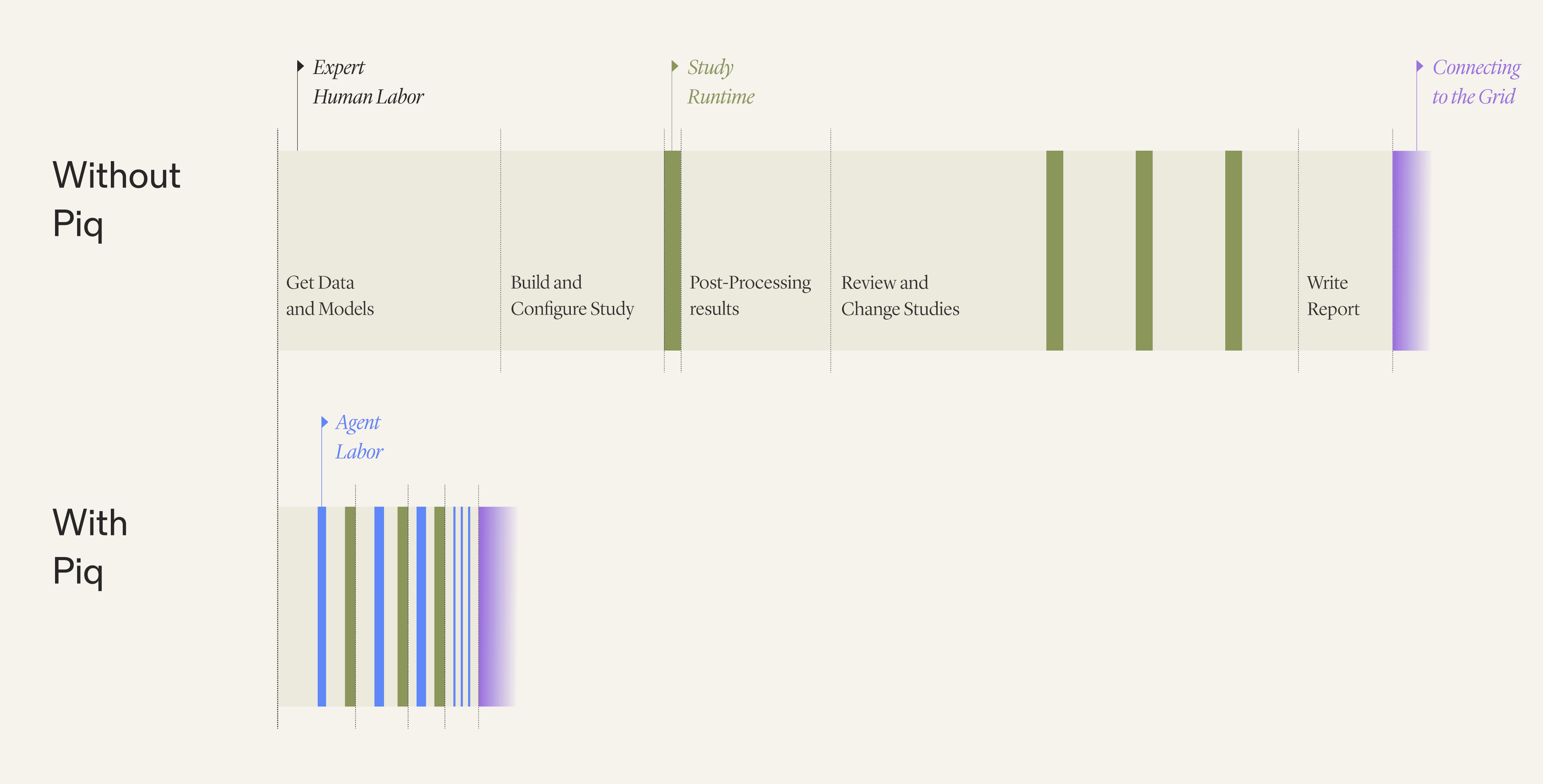
All of the work I mentioned around the simulation—data cleaning, scenario preparation, post-processing result, etc..—is exactly what Piq takes on. So a study that used to take months comes back in minutes, and rerunning it with a new assumption costs almost nothing. For our early customers, this changed what they can ask for compared to their other options: more sites, more ways to unlock existing capacity, customized results built off their world view. In other words, real acceleration, and a real edge.
This speed is what makes the breadth practical. Developers use Piq to screen thousands of sites across the US, in markets like ERCOT, PJM and MISO, then run a customized study on whichever point of interconnection looks best. The same technology that accelerates interconnection studies is already being used to validate dynamic and EMT plant models and unlock flexible capacity. Utilities and system operators run the same kinds of studies on their own networks for integrated resource planning, and grid enhancing technology screening.
Trust and auditability
There are no black boxes in Piq, and we’ve been very intentional about building this way. Every result traces back to a given network model or plant model version and the assumptions and the simulation engine that produced it. The engines are the same industry-standard tools that engineers and regulators already trust. Our job is orchestrating those tools well, versioning everything and making the work repeatable, not replacing physics with a black box.
This no black box approach matters because our customers make decisions worth hundreds of millions of dollars on these results. Numbers that nobody can check or reproduce are not worth much. Any engineer, at a developer, a utility or an ISO, can open a study and see exactly how we got there.
Human expertise
Automation is only as good as the people who designed it. Our team has deep expertise across load flow, short circuit, stability and EMT studies. This breadth of expertise within one cohesive team is rare, including among the companies now selling AI into this market, but it's core to our DNA and founding insights.
The goal has always been to 100x every power systems engineer, not to replace them. We’ve built a platform that keeps humans in charge–a beautiful UI to dig into grid models more effectively than ever before, alongside AI collaborators who take on the repetitive work of building cases and running studies, while logging all of the versions and changes. The engineers stay in charge of the judgment calls, the review, and the sign-off.
What the new look means
We built the new identity together with our incredible design partners at Draft, and each aspect of it connects to how we work.
• Trust: engineering diagrams and a paper grain give it the feel of work an engineer can follow and check, the way planning on paper always could be.
• Speed: motion runs throughout, starting with the animation at the top of the homepage.
• Breadth: the imagery covers many kinds of grid assets, each shown both as it is modeled electrically diagram and as it stands in the built world.
• Human expertise: the design is intentionally human, familiar, and comforting, not a cold dark machine in space.
What comes next
The next phase of our work is with utilities, large load developers, and generation and BESS developers. This is fundamentally the same agentic planning we first proposed in 2023, but faster and on a larger scale. The new look gives us a foundation for sharing more about Piq and about the biggest problems facing the grid.
If your mission involves unlocking the grid, we'd love to talk.
Unlock
the grid.

